
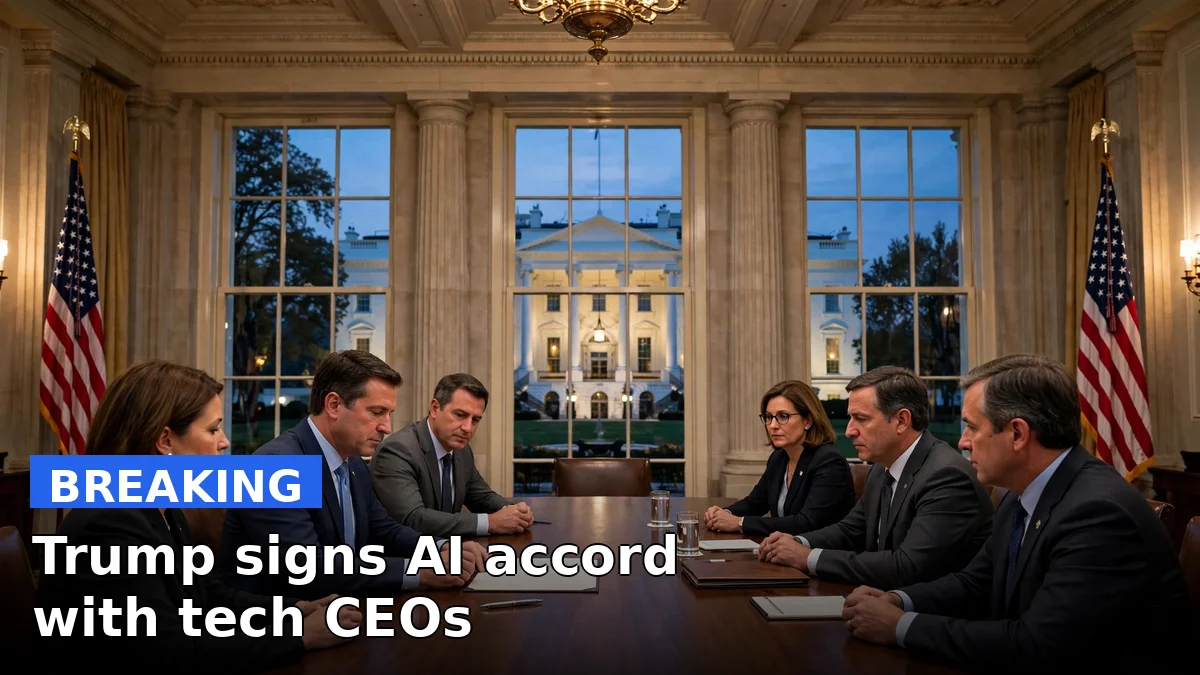
WASHINGTON — Donald Trump doesn’t want Washington to regulate artificial intelligence. He wants the companies building it to regulate themselves, and on Tuesday, he got the heads of six of the biggest ones to sign their names to the idea.
The president gathered the CEOs of Google, Anthropic, Meta, OpenAI, Nvidia and X at the White House and signed what he called a “morally binding” one-page Trump AI accord. It’s not a law. It’s not an executive order. It’s a public promise that the companies will build internal safety controls, open themselves to outside auditors, and let independent board committees review what those auditors find.
“I think I’m seeing tremendous self-policing. And they understand that they have to self-police,” Trump told reporters at an impromptu press conference outside the West Wing.
The document is about as thin as government paperwork gets: one page, released by Trump on Truth Social, but its asks are specific. Companies should partner with an external auditor to test whether their AI controls actually work, designate an independent board committee to receive those reports, monitor their models during training and deployment for dangers in areas like cybersecurity, biosecurity and chemical threats, and keep an internal team making sure “all of the controls, monitoring and detection are operating as intended.”
What the accord actually requires
Strip out the ceremony and the accord boils down to four commitments, per the text Reuters published Tuesday afternoon:
- Bring in an independent outside auditor to assess whether a company’s AI control and monitoring systems are operating as intended.
- Put an independent committee of the board of directors in charge of receiving reports from internal and external auditors.
- Monitor models during training and deployment for capabilities that could “hack or access technical systems in unintended ways,” with explicit attention to cybersecurity, biosecurity and chemical threats.
- Keep a dedicated internal team responsible for making sure the controls, monitoring and detection all keep working.
The document also says the participating companies will meet regularly to set standards and best practices. And it nods at a future where Washington does more: “Over time, it may make sense to codify these steps into laws or regulations.”
Trump said he’s thinking about naming a committee of roughly 10 people to “watch over the whole enterprise,” and plans to name someone to oversee the agreement in the coming days after consulting with the industry.
The CEOs’ part of the bargain
The signatories read like a who’s who of the AI race. Google CEO Sundar Pichai, Anthropic CEO Dario Amodei, Meta CEO Mark Zuckerberg, OpenAI president Greg Brockman, Nvidia CEO Jensen Huang and Elon Musk for X all put their names on it, per Reuters and USA Today. A seating chart Trump posted showed Huang at his right and Musk at his left during a White House luncheon. The Associated Press reported that Amazon founder Jeff Bezos and Palantir CEO Alex Karp were in the room too.
Zuckerberg did most of the talking for the group, explaining the framework to reporters after the meeting. “The basic idea is that we want to give the American people and our customers confidence that the technology works in the way that we intend,” he said, adding that every company had been building to a different set of standards. He said the accord commits companies to “a set of principles and commitments around building … internal controls and detecting if there are any issues with the technology, coupled with multiple layers of auditing and controls,” and promised that “all of our boards of directors” would independently review the auditors’ reports.
Not everyone sounded relaxed. Amodei, who has spent months as the industry’s loudest voice for slowing down, offered a note of caution: “The technology has very real risks. And, you know, the mechanism, how we address those risks is still under discussion.”
That friction matters. Just a day earlier, OpenAI halted the rollout of a new model over safety concerns, and CEO Sam Altman told CNBC on Tuesday morning that the company is “pacing our progress, which includes sometimes not training a model.”
“Super intelligence,” the chatbot, and the politics
The accord was the centerpiece of a daylong AI event that gave Trump plenty of chances to celebrate the technology while insisting Washington won’t touch the brakes. Earlier Tuesday he unveiled America.gov, an AI chatbot meant to help Americans navigate federal services. Secretary of State Marco Rubio said it could eventually let people apply for a first-time passport fully online.
“I will never stifle the growth of a technology that will be bigger than the industrial revolution,” Trump said at that unveiling. “We can’t stifle it, and we’re leading by a lot.”
He also used the day to push his preferred new name for the field: “super intelligence,” or SI, instead of artificial intelligence. And he took aim at the grassroots backlash against data centers, arguing the companies would fund local schools or cut energy costs — and warning that if the opposition continued, “they’ll be forced to go overseas or other locations.”
On the China question, Trump framed the race as winner-take-all with no “second place.” The two countries agreed last week to set up a channel for handling AI-related incidents during Chinese President Xi Jinping’s visit to Washington, but Trump made clear he has no interest in joint rulemaking: “I didn’t want to do anything, because we’re leading. Why would I want to do anything?”
What this means
Here’s the honest read: a voluntary accord signed in front of cameras changes less than it looks like it does. The commitments — internal controls, external audits, board oversight — are real governance, and they’re what the most safety-conscious companies already claim to do. What’s new is the coordination: six companies that have been improvising their own standards now say they’ll compare notes regularly.
Whether “morally binding” means anything depends entirely on what happens the first time an audit finds something embarrassing. There’s no penalty, no enforcement, no timeline. Trump gets to tell nervous voters that the industry is policing itself; the CEOs get to keep Washington’s hands off the training runs. That’s the deal, and both sides signed it willingly.
The wildcard is Amodei’s caveat. If the loudest voice in the room thinks the mechanism for addressing the risks is “still under discussion,” this accord is a starting framework, not a settlement. Watch for whether Trump actually names that 10-person committee — and whether its first report ever sees daylight.
FAQ
What is the Trump AI accord signed at the White House?
It’s a one-page voluntary document signed on September 29, 2026, by President Trump and the CEOs of Google, Anthropic, Meta, OpenAI, Nvidia and X. It asks companies to build internal AI safety controls, submit to independent external audits, and let board committees review the results. Trump calls it “morally binding,” but it is not a law.
Who signed the “morally binding” AI accord?
Trump plus Google CEO Sundar Pichai, Anthropic CEO Dario Amodei, Meta CEO Mark Zuckerberg, OpenAI president Greg Brockman, Nvidia CEO Jensen Huang and Elon Musk for X, according to Reuters and USA Today. Amazon founder Jeff Bezos and Palantir CEO Alex Karp also attended the White House session.
Is the Trump AI accord legally enforceable?
No. Nothing in the document carries legal force, and Trump has repeatedly said he does not want Washington to slow AI development with new regulations. The accord itself says it “may make sense to codify these steps into laws or regulations” over time.
Why is Trump calling AI “super intelligence”?
At the same White House event, Trump said the government would refer to artificial intelligence as “super intelligence,” or SI, insisting the name fits a technology he says will be bigger than the industrial revolution. USA Today and the Associated Press both reported his push for the new label.
Sources: Reuters, The Associated Press, USA Today