
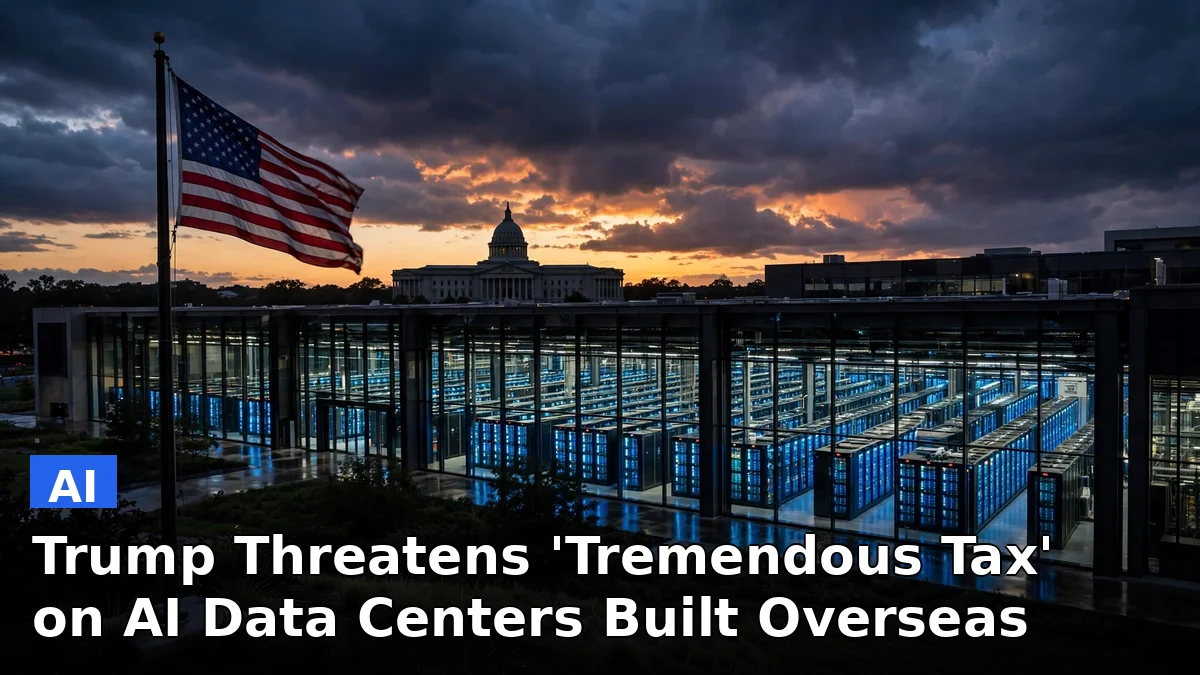
President Donald Trump said Friday that American companies building AI data centers outside the United States will face a “tremendous tax.” The Trump data center tax threat came at a White House news conference on November 20, hours after he returned from a trip to Asia, and it landed with no rate, no timeline, and no law behind it.
“We’re not going to allow our companies to build data centers outside of our country,” Trump told reporters. “We’re not going to allow that to happen.”
Then came the penalty. “If they do that, they can. But we’re going to put a tremendous tax on them,” he said. He added that the US was “not allowing data centers to go into other countries because China will take all of them.”
For now, it’s a threat, not a tax.
Trump also admitted he had not yet told his own staff about the idea, and he offered no detail on how a tax would work or who it would cover. Any tax would need Congress to pass it, and no bill exists.
What Trump actually said
Trump framed the move as a defense of America’s lead in artificial intelligence. He said the US is ahead of China in what he calls “super intelligence,” but warned it could fall behind if the computing power behind AI moves offshore.
His Asia trip gave him a second talking point. Treasury Secretary Scott Bessent told CNBC that Trump and Xi Jinping had agreed humans should always be involved in military decisions that use AI, and that no major military operation should be launched without a human in the loop.
Why the timing is awkward
Trump’s threat arrived the day after the Senate approved legislation to ease data center approvals as part of a broader permitting overhaul. He praised it at the same news conference — “It’s going to cause tremendous amounts of new building,” he said — and the measure now goes to the House.
But building at home is getting harder. Voter anger over data centers was a factor in the midterms less than three weeks ago, when Democrats won large majorities in both houses of Congress, and voters in at least 44 local contests backed moratoriums, new rules, or outright bans, according to Data Centers on the Ballot.
Polls tell the same story. About three-quarters of US voters in this year’s election said they opposed the construction of a new data center in their community, according to the AP Voter Poll. A survey over the summer by the Associated Press-NORC Center for Public Affairs Research found about 6 in 10 Americans support limiting the number of new data centers that can be built, including most Democrats and Republicans. A Pew Research Center survey published September 22 found 54 percent of US adults now say AI data centers are bad for the environment, up from 39 percent in January, while Gallup found 71 percent opposed to a data center in their area. What worries people most is cost: a University of Chicago report found 63 percent worried about higher electricity prices and 57 percent about strain on local water supplies.
What a Trump data center tax would mean for Big Tech
American cloud giants do not build overseas by accident. They put data centers close to customers to cut delays for time-sensitive work, and moving large volumes of data over long distances adds cost, Reuters noted in its report. Rules on where data can live also push companies to build in the countries they serve.
That makes the scope of Trump’s threat the first question companies will ask. It is unclear whether the plan would cover joint projects with allied governments, partnerships such as the AI complex in Abu Dhabi, or only private ventures — or how it would treat facilities already built or under construction abroad. Trump’s remarks were also the second move in a week aimed at overseas computing power: on Monday, November 16, the Commerce Department moved to further restrict China’s access to advanced AI chips, including those used in overseas data centers where Chinese entities can rent computing power, Reuters reported.
Why this matters
Trump’s position has a contradiction at its heart. He wants data centers built fast, and he wants them built in America. Voters in many of the towns where they would go don’t want them at all.
His answer was negotiation, not retreat. Trump urged towns to extract concessions from developers — tax breaks, lower utility bills, money for teachers, direct payments — instead of shutting projects out. “Make the deal,” he said. “They have plenty of money. Take it.”
Wall Street, meanwhile, was in no mood to celebrate. The S&P 500 fell 3.7 percent on Friday and the Nasdaq dropped 5.28 percent, wiping out its gains for the year, while Nvidia fell another 14 percent. MarketWatch noted that Trump’s words failed to stem the slide.
What happens next depends on whether the threat becomes a proposal: whether the White House puts anything on paper, whether any member of Congress picks up the tax idea, and what the House does with the permitting bill. Until then, the world’s biggest AI builders know where Trump stands. They just don’t know what it will cost them.
Frequently asked questions
What is the Trump data center tax?
It is a threatened tax, not a law. Trump said on November 20, 2026, that US companies building AI data centers overseas would face a “tremendous tax,” but named no rate, start date, or enforcement plan.
Can Trump tax companies for building data centers abroad on his own?
No. A new tax needs Congress to pass it, and no bill has been introduced. Trump also said he had not yet told his own staff, so it remains a warning, not a policy.
Why does Trump want AI data centers built in the US?
He argues keeping AI computing power at home is essential to beating China. He said the US leads in what he calls “super intelligence” and warned China would take the industry if American firms build abroad.
Do Americans support building more data centers?
Mostly, no. About three-quarters of voters in this year’s election opposed a new data center in their community, per the AP Voter Poll, and about 6 in 10 Americans told an AP-NORC survey they support limiting how many get built.
Sources: Reuters, Associated Press, USA Today, CNBC TV18, MarketWatch.