
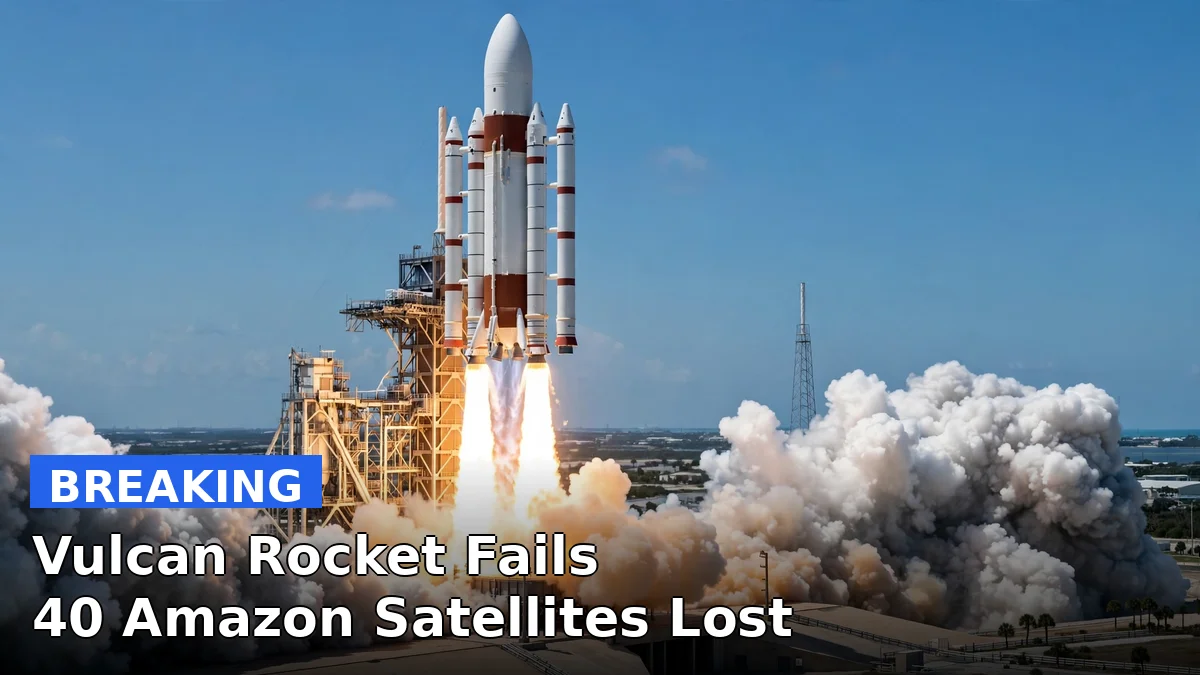
A United Launch Alliance Vulcan rocket failed about 10 minutes after liftoff from Cape Canaveral on Sunday, destroying all 40 of Amazon’s Leo internet satellites on board and handing ULA its first outright mission failure in 20 years.
The 214-foot rocket lifted off from Space Launch Complex 41 at 12:40 p.m. ET, at the very end of a 29-minute launch window, after a hold at T-minus 20 seconds over a pressure-reducing valve problem. ULA confirmed the loss about 50 minutes later in a short statement on its website.
“Based on data received by our Launch Director, we confirm that the Vulcan vehicle launched from Space Launch Complex 41 suffered an anomaly 10 minutes into the flight and failed to deliver the Amazon mission to orbit,” ULA said. “We will work closely with our customer and other appropriate organizations to find the cause, determine the appropriate corrective action and return to flight as quickly as possible.”
It was only the fifth Vulcan flight ever.
What we know about the ULA Vulcan rocket failure
The early part of the flight looked normal. All six solid rocket boosters peeled away about a minute and 35 seconds after liftoff, and the Centaur V upper stage ignited after stage separation. ULA’s last public update before the failure put the vehicle 95 miles above Earth, east of Charleston, South Carolina, with its payload fairing already jettisoned.
Then the trouble started. NASASpaceFlight reported that the anomaly struck during the Centaur upper stage’s first burn, on the first flight of a version of Centaur tuned for low Earth orbit. ULA has not said what went wrong.
“Since the anomaly just occurred, we don’t have any specific data yet to understand what occurred today,” the company said in its update.
What happens next is an investigation. NASA Administrator Jared Isaacman said the space agency is ready to help ULA work through the failure. ULA has not said when Vulcan will fly again.
A comeback flight nine months in the making
Sunday’s launch was supposed to be a fresh start. Vulcan had not flown since February 12, when a solid rocket booster nozzle malfunction marred the USSF-87 national security mission. A similar nozzle problem had already shown up on the rocket’s second flight in October 2024. ULA and booster supplier Northrop Grumman spent nine months working through the recurring issue with the GEM-63XL boosters before clearing Vulcan to fly again.
Vulcan is the rocket ULA built to replace its Atlas V fleet. ULA is a joint venture of Boeing and Lockheed Martin, formed in 2006, and until Sunday it had never lost a mission outright across roughly 170 flights of its Delta IV, Atlas V, and Vulcan rockets. That record was the core of ULA’s pitch to the Pentagon and to commercial customers: boring, dependable, on time.
The failure breaks that streak at the worst possible moment for the company, as ULA tries to prove Vulcan can fly often enough to pay for itself.
What the loss means for Amazon’s Leo network
For Amazon, the stakes are just as high. The flight, called Leo 1, was the first of 38 Vulcan launches Amazon has booked to build its Leo broadband constellation, a direct rival to SpaceX’s Starlink, and the 40 satellites would have been the largest single group launched so far.
Amazon still has nearly 400 Leo satellites in orbit, so the network is far from dead. But the schedule doesn’t leave much slack. Amazon needs 578 satellites in orbit to start initial service, and federal rules require it to have half of its 3,232-satellite first-generation constellation, 1,616 satellites, in orbit by July 2028.
A grounded Vulcan puts real pressure on that clock. Vulcan was meant to carry the heaviest load of the program, 38 flights, so every month it sits on the ground while investigators work, the gap gets harder to close.
Why this matters
There’s a bitter irony in where the failure happened. ULA grounded Vulcan for nine months to fix a booster problem, then lost the rocket on the upper stage instead. Nobody at ULA has suggested a link between the two. But it does mean the company’s return-to-flight work now starts over from a different place, with a new failure to explain.
For the wider launch market, Sunday is a reminder of how thin the margin is. SpaceX flies so often that a single Falcon 9 loss barely dents its schedule. ULA flies a handful of times a year, so one failure eats a much bigger share of its manifest and its reputation. Vulcan’s next flight, whenever it comes, will carry that weight too.
The investigation will tell us whether this was a one-off defect or something deeper in the Centaur upper stage. Until then, Amazon’s satellite clock keeps ticking, and ULA’s perfect record is history.
Frequently asked questions
What happened to the ULA Vulcan rocket on November 15?
The Vulcan rocket suffered an anomaly about 10 minutes after liftoff from Cape Canaveral and failed to deliver its 40 Amazon Leo satellites to orbit. ULA confirmed the loss about 50 minutes after launch.
Has a ULA rocket ever failed before?
No. This was the first outright failure of a United Launch Alliance rocket since the company was formed in 2006, ending a run of about 170 missions without a total loss.
How many Amazon Leo satellites were lost in the Vulcan failure?
All 40 satellites on board were lost. Amazon still has nearly 400 Leo satellites in orbit, and it needs 578 in orbit to start initial service.
When will ULA’s Vulcan rocket fly again?
ULA has not given a date. The company says it will work with Amazon and other organizations to find the cause, decide on corrective action, and return to flight as quickly as possible.
Sources: Reuters, Florida Today (USA Today Network), Spaceflight Now, NASASpaceFlight.