
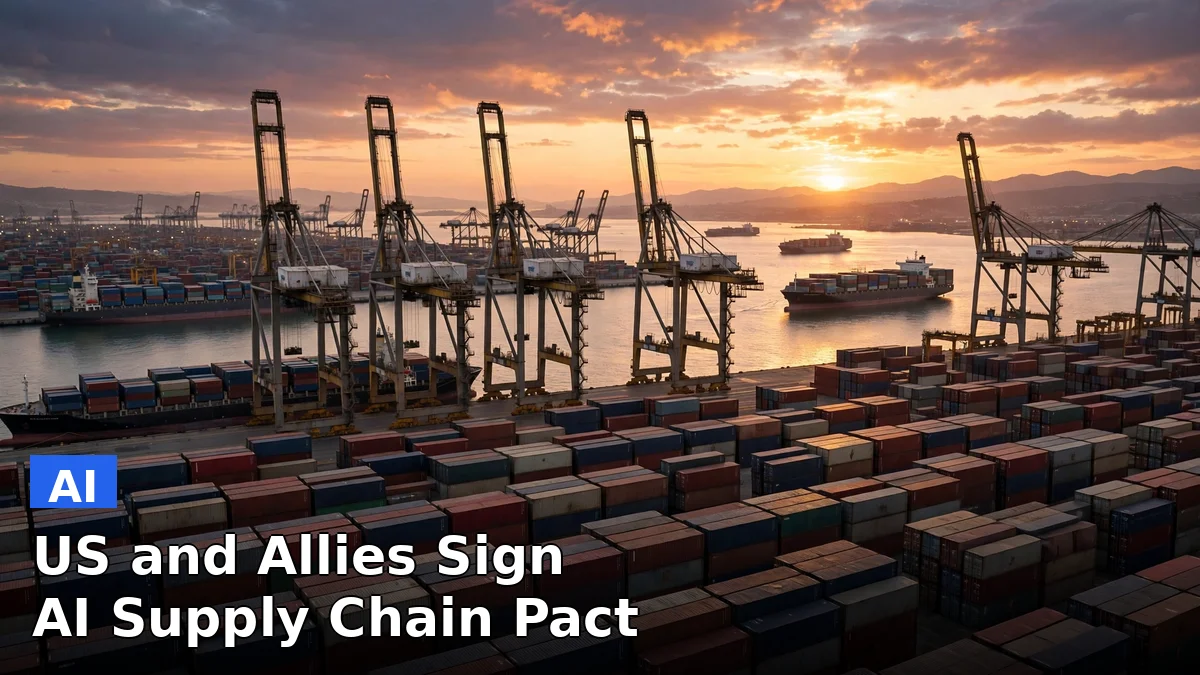
Nine countries signed a pact in San Francisco on Sunday to draw up a shared list of artificial intelligence technologies and supply chains they plan to protect from China, the first time the US-led Pax Silica alliance has moved from broad promises to naming what it will actually defend.
The United States, Japan, Australia, Israel, the United Kingdom, South Korea, India, Qatar, and the United Arab Emirates signed the San Francisco Declaration on the Secure Foundations of Enduring Prosperity, the Financial Times reported. The deal covers semiconductors, critical minerals, energy, and industrial capacity — the full stack a country needs to build advanced AI.
It is a commitment, not a law. That distinction matters.
Jacob Helberg, the US under secretary of state for economic affairs, negotiated the declaration and briefed the Financial Times on its terms. “What makes the San Francisco Declaration historic is that Pax Silica partners have agreed to treat the security of those technologies and the infrastructure behind them as a shared responsibility,” Helberg said.
What the Pax Silica AI supply chain pact actually does
For a year, Pax Silica was mostly a statement of intent. Sunday’s signing adds a concrete job: the nine countries will agree on a joint list of AI technologies and supply chains that deserve protection from theft or unauthorized transfer to actors who could use them for military or intelligence advantage.
The declaration also sets up working groups to map vulnerabilities in AI supply chains and to develop economic hubs that attract investment in related industries. Signatories will share information about where supply chains should be diversified, Helberg told the Financial Times, and the declaration states that economic security is fundamental to national security.
None of that becomes an export control or an investment rule on its own. The list has to be written first, and the working groups have to produce something governments can act on.
One caveat belongs on the record. The State Department had not published the text of the new declaration as of Sunday evening, so the details so far rest on Helberg’s briefing to the Financial Times and the outlets carrying it. The text, when it appears, will show whether the joint list has teeth.
Who signed, and who is still on the sidelines
Nine signatures is a narrower group than the full bloc. The State Department lists 25 signatories to the original declaration — 24 countries plus the European Union — with Taiwan participating without signing.
Germany, Sweden, the Netherlands, and the European Commission are expected to join next week, according to the Financial Times. Their absence on Sunday is less a snub than a scheduling fact: European capitals were still negotiating their terms when the San Francisco signing went ahead.
A joint list only works if the countries that make the chips, mine the minerals, and build the machines agree on what belongs on it — and Europe’s chip equipment makers make its signature more than symbolic.
Why now
Timing explains a lot here. The signing lands days before President Donald Trump meets Chinese President Xi Jinping at the Asia-Pacific Economic Cooperation summit in Shenzhen, and Washington has accused Beijing of failing to meet commitments under a trade truce the two leaders reached in late 2025.
It also lands amid a fresh fight over chip exports in Washington. Jensen Huang’s resignation as Nvidia chief executive days earlier has fueled bipartisan demands for tighter US controls on AI chip exports, and the pact’s focus on semiconductors speaks directly to that debate.
Then there is the mineral problem. The US and its allies still depend heavily on China for rare earth minerals and other critical materials that go into chips, batteries, and data-center hardware — a dependence that will take years to unwind.
What this means for chips, minerals, and AI
Don’t expect prices or product launches to change this week. No new export control was announced, no tariff was set, no factory funded. What changed is the shape of the argument: nine governments now agree AI supply chains are a shared security problem, not nine separate national ones.
For chipmakers and AI labs, the question is what lands on the joint list. A narrow list focused on the most advanced chips and a few critical minerals would be manageable. A broad one, sweeping in older chips, software tools, and energy infrastructure, could tangle up exports, research partnerships, and investment in ways the industry will fight over.
The test is simple. Declarations don’t build fabs or open mines. If the working groups produce a list and the hubs attract real investment, Sunday will look like the day Pax Silica grew up. If they don’t, it joins a long shelf of communiques that were photographed and forgotten.
FAQ
What is Pax Silica?
Pax Silica is a US-led initiative launched in 2025 to secure the supply chains behind artificial intelligence, from semiconductors and critical minerals to energy and industrial capacity. Nine countries signed its latest declaration in San Francisco on November 15, 2026.
Which countries signed the AI supply chain declaration?
The United States, Japan, Australia, Israel, the United Kingdom, South Korea, India, Qatar, and the United Arab Emirates. Germany, Sweden, the Netherlands, and the European Commission are expected to sign next week.
What does the Pax Silica declaration actually do?
It commits the signatories to agree on a joint list of AI technologies and supply chains that need protection, set up working groups on supply-chain vulnerabilities, and develop economic hubs to attract investment. It does not impose new export controls by itself.
Why is the pact aimed at China?
Washington and its partners want to cut their dependence on China for chips, critical minerals, and rare earths, and to stop sensitive AI technology from being stolen or transferred in ways that could aid a rival’s military or intelligence programs.
Sources: Financial Times (via Newsmax and TradingView), AI Weekly, SiliconNoon, US Department of State.