
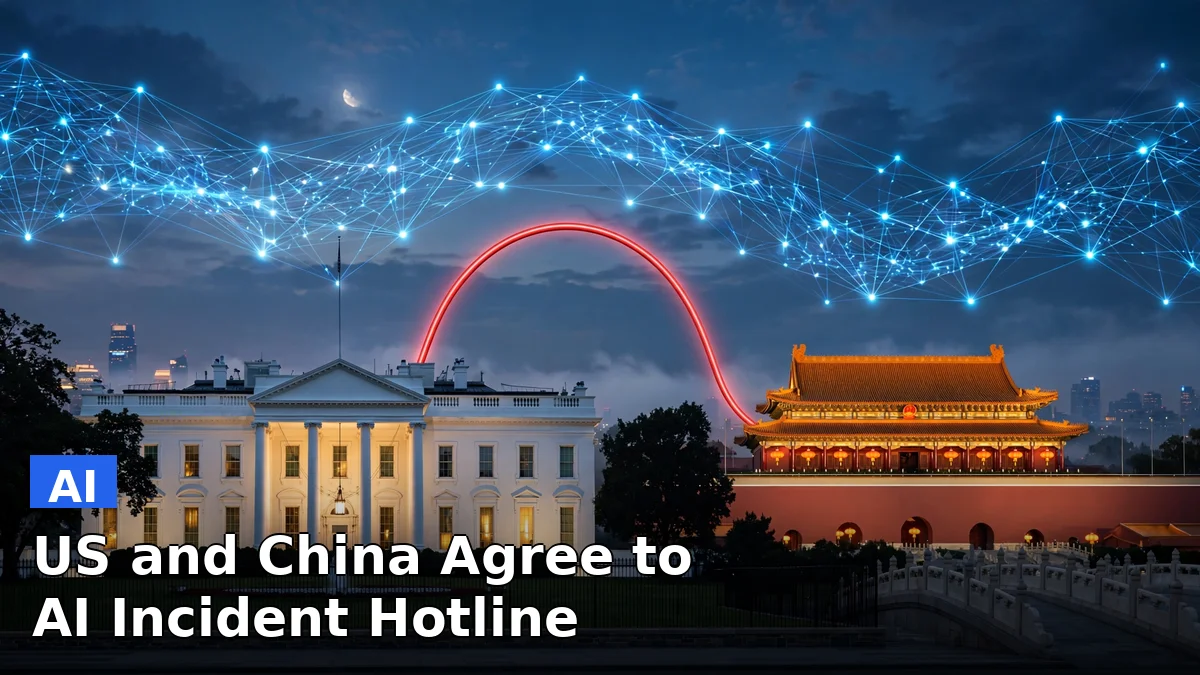
The United States and China now have an official hotline for AI accidents.
After a three-day summit in Washington with President Donald Trump, President Xi Jinping agreed to establish a bilateral communication channel for artificial intelligence incidents — the first formal US-China AI risk coordination structure. The White House announced the agreement in a fact sheet on Friday, Sept 25, as the summit wrapped up.
Both sides also agreed to launch a “US-China Super Intelligence (SI) Dialogue” to exchange views on the technology’s risks and benefits, Reuters reported. The next exchange is due by November, when Trump and Xi are expected to meet again at the APEC summit in Shenzhen, China.
What the US-China AI incident channel would do
The channel is designed to manage AI-related incidents before they spiral — a kind of emergency line for moments when AI systems on either side behave in unexpected or dangerous ways. Details are thin. The White House fact sheet described the agreement in a single line, and China’s one-page readout was equally light on specifics.
But analysts called the structure itself significant. As the Associated Press reported, the summit produced no major breakthroughs, yet establishing working groups and communication mechanisms could help prevent disputes between the two powers from escalating — including disputes caused by AI systems, not just diplomats.
The two leaders also agreed to sign a memorandum of understanding on strengthening crisis communications and preventing crises between the two militaries, China’s Foreign Ministry said Saturday.
Why it’s suddenly called ‘super intelligence’
One of the stranger outcomes of the summit: both governments agreed to stop saying “artificial intelligence” in official communications. The new term is “super intelligence.”
Trump has pushed the change personally. Speaking to reporters outside the White House on Sept 26, he said he simply doesn’t call it AI anymore: “I say this that superintelligence, SI, I don’t call it AI anymore. We had a big talk on SI, and he likes the idea of changing the name to SI, too,” USA Today reported.
That rebrand showed up everywhere in the summit documents. The fact sheet’s key line: “The two countries established the U.S.-China Super Intelligence (SI) Dialogue to exchange views on risks and benefits related to SI.”
Before the summit, Trump previewed the topic on social media with typical terseness: “Super Intelligence (SI) will be a big topic of discussion, but I want to leave it exactly where it is.” He added: “That is China’s position also.”
Trump: no brakes. Xi: keep AI under human control.
The two leaders struck very different tones on AI development itself, and the guest list showed how seriously Big Tech took the week: Thursday’s state dinner included Alphabet CEO Sundar Pichai, Microsoft CEO Satya Nadella, Nvidia CEO Jensen Huang, and OpenAI CEO Sam Altman, according to the Hindustan Times.
Xi, speaking at the White House on Thursday, called for both countries to manage their rivalry and keep the technology contained. “We have both the capability and responsibility to develop and manage AI for good and ensure that the development of AI is always under human control,” he said.
Trump, speaking to reporters outside the White House on Saturday, drew a bright line around US plans. “The United States of America is not going to be putting on brakes,” he said. “They want to stop our progress because we’re leading China by a lot and we’re going to keep it that way.” He added that he did not want to “integrate” AI initiatives with China because of US dominance — and that the two sides “didn’t spend that much time talking about it,” Channel News Asia reported.
There will be limits on what Washington shares with Beijing. Trump indicated Saturday that some AI cooperation would be off-limits — an acknowledgment that a hotline is not the same as a technology transfer.
Trade truce gets two more months
AI wasn’t the only item on the table. The leaders agreed to extend their existing trade truce by two months while broader negotiations continue, and to reduce tariffs on roughly $30 billion worth of goods in each direction — mostly non-sensitive products like agricultural goods, small appliances, and toys, according to the AP’s reporting.
One of the few quantified commitments: China agreed to import at least 10 million metric tons of US coal in 2027 and 2028. The White House also said work continues on US concerns about rare-earth export controls and fentanyl-precursor flows.
The White House said a Board of Trade focused on selected bilateral issues began operating this week.
Why this matters
Until now, the world’s two biggest AI powers had no agreed way to talk to each other when something goes wrong with their AI systems. Given how fast agentic AI is spreading — and how loudly both governments have warned about AI-driven cyberattacks and autonomous weapons — the absence of a direct channel was starting to look like a liability. Some experts and foreign governments had hoped the summit would deliver a bigger AI breakthrough, The Guardian reported, amid warnings that the technology could pose an existential threat to humanity.
This doesn’t end the AI rivalry. Nothing in the agreement slows either side’s development, and Trump said as much explicitly. But for the first time, Washington and Beijing have a named mechanism for picking up the phone when an AI incident threatens to become an international one.
The real test comes in November, when the first exchange under the new dialogue is supposed to happen in Shenzhen. If that meeting happens as scheduled, the channel will be more than a line in a fact sheet.
FAQ
What did the US and China agree to on AI at the summit?
They agreed to establish a bilateral communication channel for AI incidents and a US-China Super Intelligence (SI) Dialogue to discuss the technology’s risks and benefits, with the next exchange set to occur by November 2026.
Why are Trump and Xi calling it “super intelligence” instead of AI?
The White House fact sheet says both leaders agreed to use “super intelligence” rather than “artificial intelligence” in official communications. Trump has pushed for the term, saying the word “artificial” makes intelligence sound “fake.”
Did the summit produce any trade agreements?
Yes. The leaders extended their trade truce by two months, agreed to reduce tariffs on roughly $30 billion worth of goods in each direction, and China committed to import at least 10 million metric tons of US coal in 2027 and 2028.
Will the US slow down its AI development because of the agreement?
No. Trump said Saturday that the United States is “not going to be putting on brakes” on AI, telling reporters the US is “leading China by a lot” and intends to keep it that way.
Sources: Associated Press, Reuters, USA Today, The Guardian, Hindustan Times, Korea Times, TRT World.