
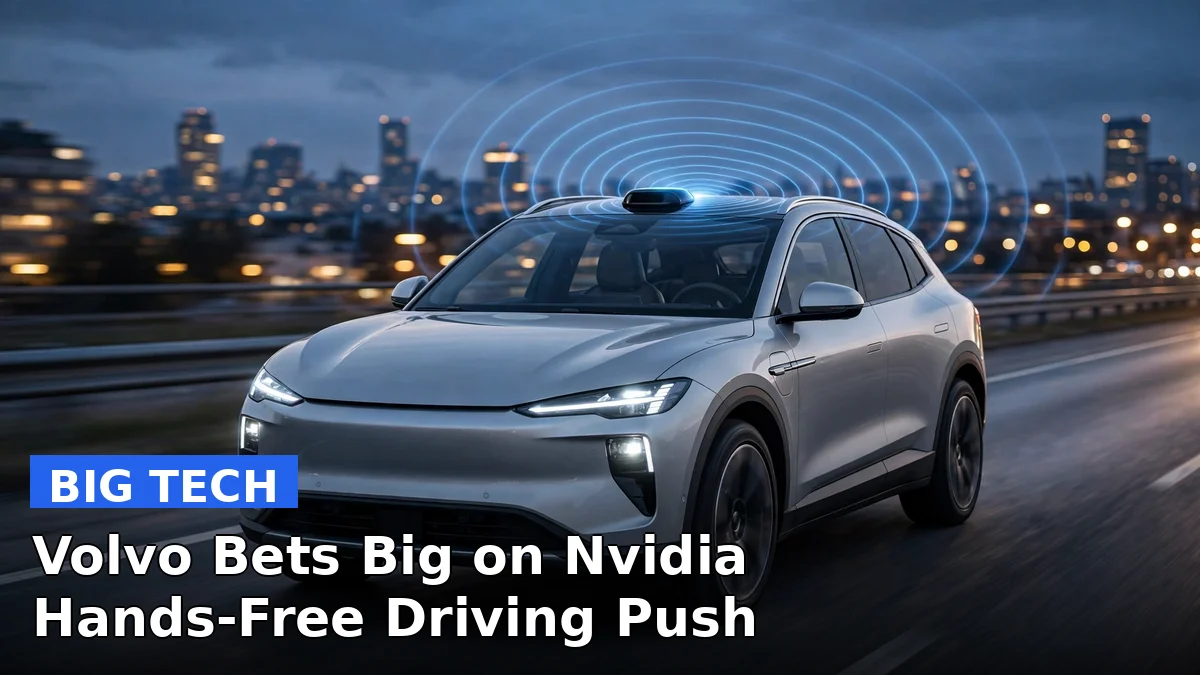
Volvo is going all in on Nvidia for hands-free driving. The Swedish automaker said Thursday it will use three pieces of Nvidia hardware and software in future vehicles to build an automated driving system that can navigate urban streets and highways on its own, deepening a partnership that stretches back nearly a decade. It’s the latest sign that car companies want chips-and-software platforms, not just parts suppliers, at the center of their cars.
The Volvo Nvidia hands-free driving deal covers the Hyperion sensor and compute architecture, the Alpamayo driving software stack, and the Halos safety evaluation layer. Volvo will combine its own safety systems and engineering with that stack in future models. The first vehicle to carry it will be a brand-new, next-generation Volvo, but it won’t arrive soon. Volvo’s head of software development, Alwin Bakkenes, said it will debut “within the decade,” adding that “then of course the technology can go beyond that.”
The three pieces of Nvidia tech
Hyperion is the hardware and sensor architecture: the computers and sensor sets that feed the car its picture of the world. Alpamayo is the driving software stack, the layer that turns sensor data into steering, braking and acceleration decisions. Halos sits on top as the safety evaluation layer, testing and validating the whole system.
Alpamayo is the most interesting of the three. According to Ali Kani, who heads Nvidia’s automotive division, the stack is deliberately redundant and diverse: it combines a family of AI models, datasets, and simulation and development tools with classical software that uses machine learning plus camera and radar perception. Both stacks run at the same time.
“The point is we run these two stacks at the same time, and we have multimodal sensors in our philosophy because it’s a safer product that way,” Kani told TechCrunch. Alpamayo is open source, and Kani said more than 650,000 developers have downloaded it, a footprint Nvidia clearly wants to turn into an industry standard.
Volvo Nvidia hands-free driving starts supervised, goes eyes-off
Don’t expect to fold your arms behind the wheel the day the first car lands. Bakkenes told Reuters the first deployment will focus on supervised driving features, with drivers remaining responsible for the vehicle. That’s today’s reality. The ambition is a gradual climb from there: hands-free driving on highways first, then in urban areas.
The roadmap goes further than hands-free. Nvidia describes the system’s end goal as a gradual introduction of eyes-off and mind-off driving, where the driver can stop watching the road under supported conditions. Volvo says the technology will handle highways, crowded urban roads and parking (the full door-to-door trip).
That climb has no fixed timetable yet. Volvo hasn’t named the first model, the price, or a launch date. It also hasn’t settled on a pricing model, though Bakkenes told Reuters the features won’t be reserved for the most expensive models.
Volvo did confirm two timeline details: the technology should appear in vehicles before 2030, and it will launch in multiple regions simultaneously — excluding China. The China exclusion is notable because Volvo is majority-owned by China’s Geely Holding, yet the company drew a clear line around where this Nvidia-powered system will roll out.
A software company that happens to build cars
Bakkenes framed the deal as part of Volvo’s identity shift. “Automakers used to be very much like car-line-based development and working with various suppliers, etc. and we have completely changed and migrated into being a full-tech stack company,” he said.
That tech stack will span the whole lineup — battery-electric vehicles, plug-in hybrids and gas-powered cars — not just EVs. Today’s Volvos already run on Nvidia silicon: every battery-electric Volvo uses Nvidia’s Orin chip, which processes camera, radar and sensor data for driver assistance. The expanded deal moves the company toward standardizing on Hyperion hardware too.
“Volvo has been synonymous with car safety for almost 100 years,” said Volvo Cars president and CEO Håkan Samuelsson. “By working with NVIDIA, we bring together two distinct strengths: industry-leading safety knowledge and world-class AI technology. That combination gives us a unique opportunity to create safer and more attractive cars for our customers.”
Jensen Huang returned the compliment in computing terms. “Accelerated computing has transformed the car into an intelligent machine that can understand the world around it,” the Nvidia founder and CEO said.
Why this matters
Volvo wasn’t the only automaker Nvidia locked in this week. Nvidia also expanded its automated-driving partnership with Mercedes-Benz, which is integrating the same core technologies (Hyperion, Halos and Alpamayo) into its own vehicles. Mercedes said the work builds on earlier collaboration with Nvidia on urban driver assistance and extends into factory AI: using AI and simulation to improve planning, production efficiency and manufacturing quality.
The race is getting crowded. Reuters noted that BMW and Ford are targeting more advanced automated-driving systems, from hands-free highway driving to self-driving operation in limited conditions. Tesla is pushing for broader approval of its assisted-driving technology in Europe, including urban areas, with an EU-wide vote possible in December.
Volvo’s edge, if it has one, is trust. The company spent decades turning seatbelts, side airbags and City Safety into reasons people buy Volvos. Now it’s betting that the next safety selling point — a car you can look away from — gets built on Nvidia’s computers. If the hardware delivers and the regulators cooperate, “eyes-off and mind-off” might finally stop sounding like a demo and start sounding like a Volvo.
Sources: TechCrunch, Reuters
Frequently asked questions
When will Volvos with the new Nvidia automated driving tech arrive?
Volvo says the first vehicle with the expanded Nvidia stack will debut within the decade (before 2030) and will launch in multiple regions simultaneously, excluding China. The first deployment will feature supervised driving, with the driver remaining responsible.
What Nvidia technology is Volvo adding to its cars?
Three pieces of Nvidia’s automotive platform: the Hyperion sensor and compute architecture, the Alpamayo driving software stack, and the Halos safety evaluation layer. Volvo will combine these with its own safety systems and engineering.
Will Volvo drivers still need to pay attention at first?
Yes. Volvo’s head of software development, Alwin Bakkenes, told Reuters the rollout starts with supervised driving features. Hands-free driving on highways and in urban areas will arrive gradually, with eyes-off and mind-off operation as the longer-term goal.
How is this different from Volvo’s current Nvidia tech?
All Volvo battery-electric vehicles already use Nvidia’s Orin computer chip for driver assistance. The expanded partnership standardizes on the newer Hyperion architecture and adds the Alpamayo software stack and Halos safety layer, aiming for full point-to-point automation rather than assistance features.